English masters moving into German or Spanish soon expose the narrow expansion allowance of a 42-character line. For adult English timed text, Netflix partner guidance specifies 20 characters per second as the maximum reading rate, alongside a 42-character line limit [Netflix Partner Help Center Timed Text Guide, 2025]. One German compound can fill much of that measure; Spanish adds articles, pronouns, and suffixes as the sentence proceeds. Linguistic editing, spotting, and line division must therefore proceed as a single operation. A sound translation still needs sufficient exposure for the eye to cross it.
Verified Benchmarks for German and Spanish Text Expansion at 42 CPL
The source track should be checked before translation for cues already nearing the line ceiling. An English row of 38 characters carrying a verb phrase and product name offers German little latitude, since one compound noun may run beyond 30 characters. Across a Spanish sentence, clitic pronouns, articles, and verbal suffixes may contribute another 8 to 12 characters. That growth calls for tighter phrasing or additional exposure time.
Both tracks warrant a working margin beneath 20 CPS, with the ceilings for each language given below. The first cuts should remove dispensable connectives; vocabulary expressing technical sense, qualification, or action must survive. Each break ought to establish a syntactic handhold for the reader ahead of the following saccade.
With burned-in delivery, every available character in the line measure acquires particular weight. As many as 75% of mobile social feed viewers mute device sound when watching in public spaces or workplaces [Verizon Media & Publicis Mobile Viewing Study, 2024]. Should a German row overrun the safe margin, those viewers may receive an incomplete rendering of what was said.
| Language | Expansion behavior at 42 CPL | Desk tactic | Desk reading ceiling |
|---|---|---|---|
| English master | 38 to 42 CPL source lines | Freeze timing as the reference track | 20 CPS |
| German | Compound nouns push lines toward 50 characters | Split at compound or genitive seams, never mid-word | Roughly 17 CPS |
| Spanish | Articles and suffixes add 8 to 12 characters | Drop redundant articles; reorder object clauses | Roughly 18 CPS |
Step-by-Step Premiere Pro and DaVinci Resolve Setup for 42 CPL Subtitles
Premiere Pro: Text Panel, Properties, and Graphics Templates
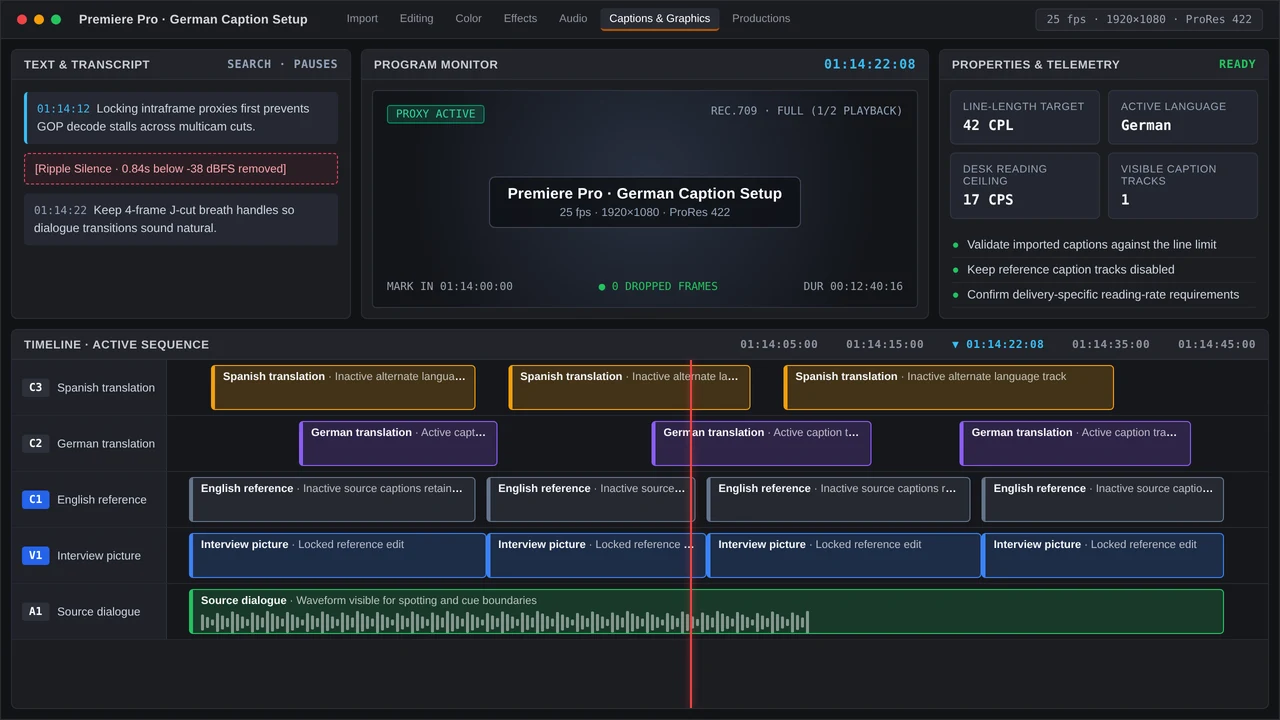
Within Premiere Pro v25/v26, use the Text panel’s speech-to-text function to generate the English transcript once; the German and Spanish SRT masters can then be imported onto caption tracks. Transcribing anew would create further timings requiring reconciliation against the reference.
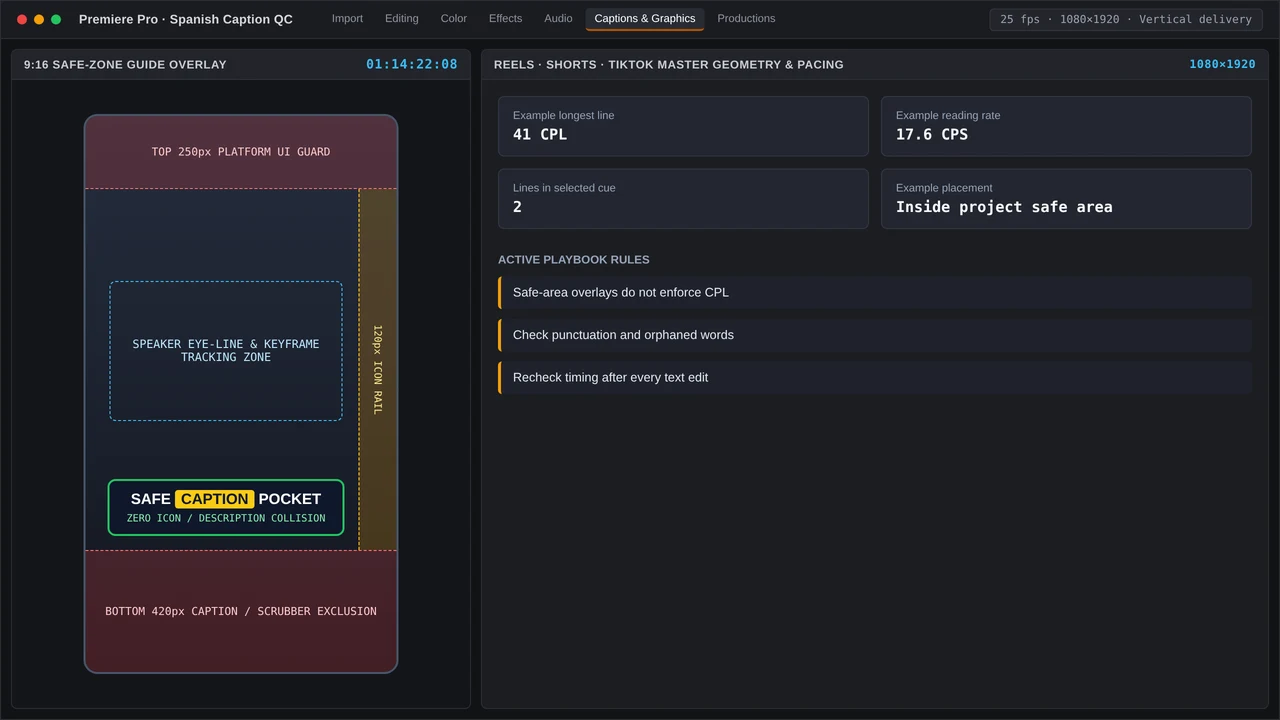
Properties should remain open throughout line-break and layout corrections so safe margins, leading, and font size can be judged as one visual system. Although a division may read cleanly inside the Text panel, its two-row geometry can sit awkwardly over the image. Load the MOGRT via Graphics Templates for the styled burned-in version, then examine those graphics at the intended delivery dimensions.
Supply SRT or VTT sidecars for closed-caption playback together with the styled MOGRT and a social reference render carrying burned-in text. If feed audio is muted and the closed track cannot be accessed or remains disabled, visible captions still provide the dialogue.
Both language tracks need re-spotting at cuts, with every cue confined to its own shot. Where dialogue is dense, a 4-to-8-frame J-cut can bring speech in ahead of the picture edit [Premiere Pro Dialogue Editing Best Practices, 2025]. Caption entry must therefore be checked against the audible onset and the incoming picture alike.
DaVinci Resolve: Caption Track and Fairlight Conform
A perpetual licence for DaVinci Resolve Studio v19/v20 costs $295. Subtitles belong on the dedicated caption track, whose frame counts should agree with the Edit-page cut list before Fairlight loudness work begins. European broadcast masters require an integrated reading of -23 LUFS; -24 LKFS is the US ATSC A/85 target [EBU R128 Loudness Recommendation, 2024].
Export SRT, VTT, or the XML handoff from the caption track after Fairlight normalization has been completed. The measured mix and subtitle exports both require review against one locked picture. Should timings change afterwards, every affected cue must be revisited.
Timeline Bottlenecks and QC Checks for 42 CPL Multilingual Delivery
Recurring faults tend to surface where departmental handovers meet. A cue may run past a shot change, a two-row stack may intrude upon the lower-third graphic area, or spotting approval may be followed by a loudness revision carrying a shifted timeline. Corrections remain tied to their relevant picture when review comments are frame-accurate. Priced at $15 per user each month, Frame.io v4 attaches timecode comments to Premiere markers directly and establishes a shared signoff reference for linguist and editor.
For a one-time $100 licence, Excalibur can automate recurrent work such as bulk nesting and centring for caption graphics. Linguistic review still constitutes its own pass because exact graphic placement offers no protection against an overfull row or a weak syntactic division.
During final QC, each row must satisfy the 42 CPL measure and remain within the two-row stacking limit; every cue then requires measurement against its language’s reading ceiling in the table. Cuts require inspection for captions carrying a word across the shot boundary. Particular scrutiny belongs to German compounds, since relocating a long word between rows may change line balance appreciably and with it the return sweep of the reader’s eye.
EBU deliverables require an integrated loudness reading of -23 LUFS. The vertical 1080x1920 render must also be played with its audio muted and examined for legibility, clipping, and collisions with graphics. Timecode syntax in SRT and VTT must be validated using the burned-in reference so visible captions and sidecar files share identical cue boundaries.
Routine distribution has to accommodate these checks because video viewing now operates at considerable scale. Among weekly podcast consumers in the United States, 46% favour active-video podcast viewing over audio-only feeds [Edison Research Infinite Dial & Podcast Consumer Report, 2025]. YouTube’s podcast content reaches a monthly active audience of more than 1 billion viewers [YouTube Official Blog, 2025]. Each German and Spanish version should keep its approved reference render alongside the subtitle exports, with every sidecar reopened against that picture before release.